Marathi Grammar
Marathi Verbs & Tenses (with Examples)
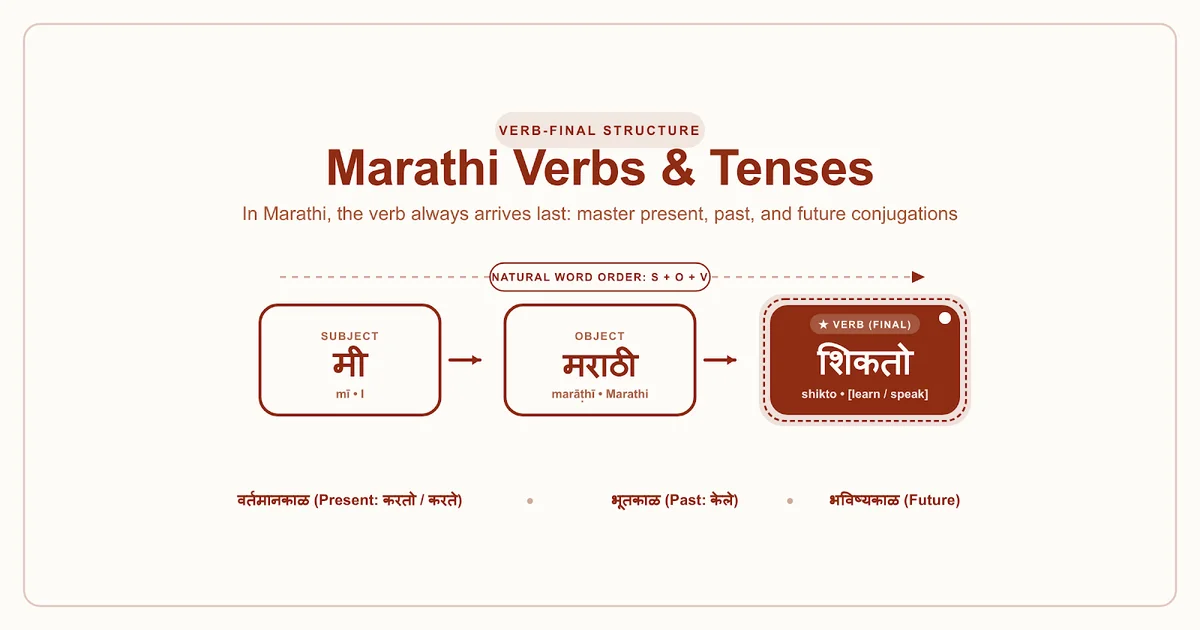
How Marathi verbs work — everyday verbs, continuous tense and the SOV sentence pattern, compared with Hindi.
What you will learn
How Marathi verbs work — everyday verbs, continuous tense and the SOV sentence pattern, compared with Hindi. Notes below come straight from the Bol Marathi lessons.
How Marathi verbs work: movement and compound verbs, ability and obligation forms, the introductory verbs lesson from Unit 01, and advanced passive and causative voice from Unit 21. Each note has Marathi explanation and English meaning. Since Marathi verbs close every sentence, this topic pairs naturally with sentence structure and the essential-verbs word list.
Tip: Read every example to its last word — the verb is the point.
Movement Verbs · Movement Verbs
जाणे, येणे, फिरणे. मी जातो, मी येतो.
Movement verbs: jāṇe (go), yeṇe (come), phiraṇe (stroll). Examples: mī jāto (I go), mī yeto (I come).
Note: कुठे, इथे, तिथे.
From Unit 04
Compound Verbs · Compound Verbs
सुरू करणे, पूर्ण करणे, प्रयत्न करणे.
Compound verbs with karaṇe (to do): surū karaṇe (to start), pūrṇa karaṇe (to finish), prayatna karaṇe (to try). Loanword nouns attach to karaṇe.
Note: करणे + noun pattern.
From Unit 04
Ability · Ability: शकतो
मी करू शकतो. शकत नाही = cannot.
Mī karū shakto means I can do it. For cannot, use shakat nāhī after the verb stem.
Note: Infinitive + शकतो = can.
From Unit 04
Obligation · Obligation: पाहिजे
मला मराठी शिकावी पाहिजे. सोपे = easy.
Malā Marāṭhī shikāvī pāhije means I must learn Marathi. pāhije after the verb conveys must, should or want.
Note: Infinitive + पाहिजे = must.
From Unit 04
Verbs · क्रियापद • Verbs
खाणे, पिणे, जाणे, येणे, करणे.
Core verbs take the infinitive -ṇe: khāṇe (eat), piṇe (drink), jāṇe (go), yeṇe (come), karaṇe (do).
Note: क्रियापद वाक्याच्या शेवटी.
From Unit 01
Passive Voice · Passive Voice
कर्मणी प्रयोग - त्याने केलं -> तयार झालं. वाच्य परिवर्तन.
Passive voice: Tyānē kelē (he did it) becomes Tayāra jhālē (it got done) - the object moves into the subject position.
Note: कर्तृ -> कर्मणी.
From Unit 21
Causative & Permissive · Causative & Permissive
प्रेरणार्थक (करवा), अनुमतार्थक (द्या) - क्रियापद रूप.
Causative verbs add -vā/-avā to make someone do something: karā becomes karavā (get it done). Permissive uses ḍēā (let/allow).
Note: खावा = make eat. खाऊ द्या = let eat.
From Unit 21