Hindi → Marathi
Hindi → Marathi: Sentence Patterns
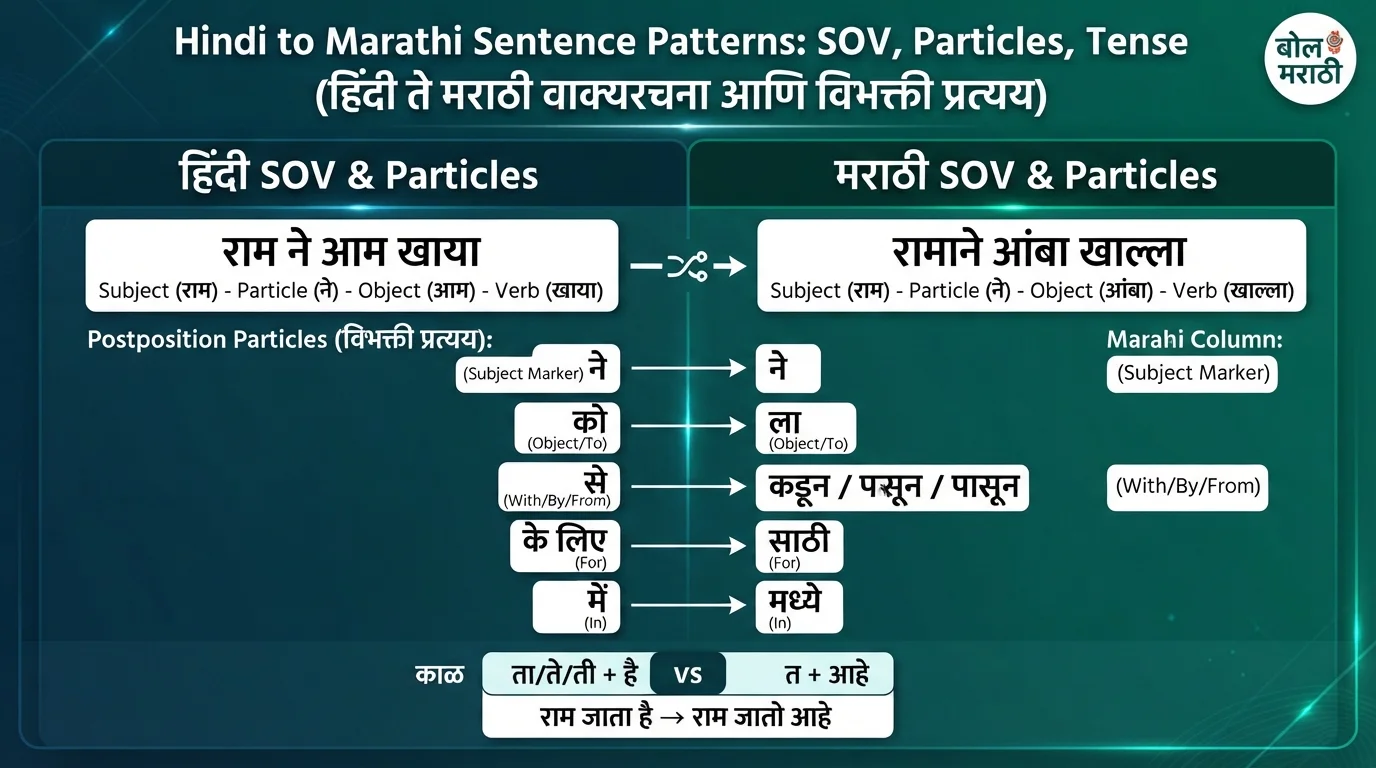
Core sentence patterns mapped Hindi to Marathi — SOV order, particles (ने, को, से), continuous tense (रहा→तो+आहे), possession — from Units 04, 05.
What you will learn
Sentence-level mappings from Units 04–05: both languages are SOV, but Marathi adds a neuter gender, fuses postpositions (मुझे→मला, को→कडून), and builds continuous tense with verb+तो+आहे instead of रहा/रही. Each row maps the Hindi pattern to the Marathi pattern with the grammar note.
The good news: word order is the same. The work is in the particles and the fused forms.
Tip: Continuous tense = verb root + तो + आहे (खातो आहे, जात आहे, बोलतो आहे). Drop रहा/रही entirely.
Hindi → Marathi, line by line
Word map
| Hindi | Marathi | English |
|---|---|---|
| go | जाणे | |
| come | येणे | |
| return | फिरणे | |
| learn | शिकणे | |
| do | करणे | |
| eat | खाणे | |
| start | सुरू करणे | |
| finish | पूर्ण करणे | |
| can | शकणे | |
| difficult | अवघड | |
| easy | सोपे | |
| need | पाहिजे | |
| required | गरज | |
| try | प्रयत्न | |
| succeed | यशस्वी | |
| fail | असफल | |
| we | आम्ही | |
| you | तुम्ही | |
| he | तो | |
| they | ते | |
| this | हा | |
| that | तो | |
| these | हे | |
| those | ते | |
| who | कोण | |
| what | काय | |
| where | कुठे | |
| self | स्वतः | |
| each other | आपण | |
| Mr | राव | |
| Mrs | बाई | |
| elder sister | ताई | |
| uncle | काका | |
| maternal uncle | मामा | |
| aunt | मावशी |
Postposition fusion
Hindi मुझे → Marathi मला, को → कडून, से → कडून, के लिए → साठी. These are single fused forms where Hindi uses a separate postposition. Memorize the fused pairs; they appear in every sentence.
The continuous tense rewrite
Hindi खा रहा हूँ → Marathi मी खातो आहे. The pattern: verb root + तो + आहे (masculine), ती + आहे (feminine), ते + आहे (neuter). No रहा/रही anywhere.
Common mistakes
✗ मी खा रहा आहे✓ मी खातो आहे
Marathi continuous = verb root + तो + आहे. रहा never appears.
✗ मुझे पसंद है for “I like”✓ मला आवडते
पसंद है has no Marathi life; the fused form is मला … आवडते.
✗ मेरा for all possessives✓ माझा (masc), माझी (fem), माझे (neut)
Three genders, three forms — the noun decides.
Quick practice
Answer first, then open the reveal to check yourself.
1. “I am eating” in Marathi?
Answer: B. मी खातो आहे — Verb root खा + तो + आहे = खातो आहे.
2. “To me” (dative) in Marathi?
Answer: B. मला — मला — the fused dative form, replaces Hindi मुझे.
3. Continuous tense marker in Marathi?
Answer: B. तो + आहे — तो + आहे (masc), ती + आहे (fem), ते + आहे (neut).
4. Translate to Marathi: “वह जा रहा है।”
तो जात आहे. — Verb root जा + तो + आहे = जात आहे.
You've bridged Hindi → Marathi.
Practice the mappings, reinforce the patterns, and speak naturally.
Common questions
Is Marathi word order the same as Hindi?
Yes — both are SOV. The differences are in particles (fused forms), gender (neuter added), and continuous tense (तो+आहे).
How do you form the continuous tense in Marathi?
Verb root + तो + आहे (masc), ती + आहे (fem), ते + आहे (neut). Example: खातो आहे, पडते आहे, बोलतो आहे.