Hindi → Marathi
Hindi to Marathi: Postpositions & Cases
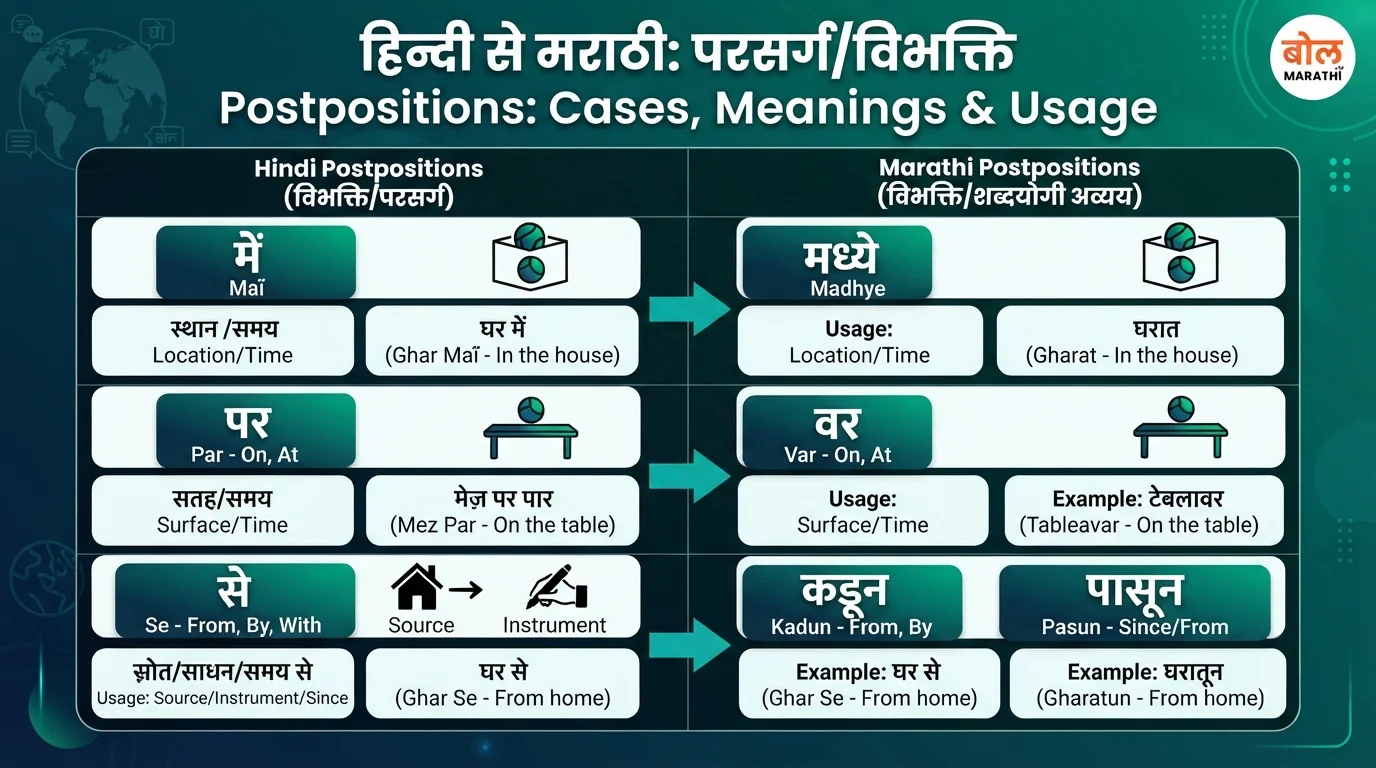
Postpositions mapped Hindi to Marathi -- cases, meanings, and usage from Unit 08. Covers में→मध्ये, पर→वर, नीचे→खाली, पास→जवळ, पीछे→मागे, से→कडून.
What you will learn
Postpositions (case markers) from Unit 08 mapped Hindi to Marathi -- the relational words that sit after nouns. Hindi में/पर/नीचे/पास/पीछे/से map to Marathi मध्ये/वर/खाली/जवळ/मागे/कडून with distinct case forms. Each row maps the Hindi postposition to the Marathi equivalent with the grammar note.
Unlike Hindi where postpositions are relatively fixed, Marathi postpositions combine with noun case endings (प्रथमा, द्वितीया, तृतीया, चतुर्थी, पंचमी, षष्ठी, सप्तमी). The base postpositions are the same, but the noun form changes: घर + मध्ये → घरात, मेज + वर → मेजवर, टेबल + खाली → टेबलाखाली.
Tip: Memorize the 6 core postpositions: मध्ये (in), वर (on), खाली (under), जवळ (near), मागे (behind), कडून (from). Then learn the noun case forms -- the postposition stays, the noun ending shifts.
Hindi → Marathi, line by line
Word map
| Hindi | Marathi | English |
|---|---|---|
| in | मध्ये | |
| inside | आत | |
| on | वर | |
| above | वरच्या बाजूला | |
| under | खाली | |
| below | खालच्या बाजूला | |
| near | जवळ | |
| beside | शेजारी | |
| behind | मागे | |
| ahead | पुढे | |
| from | कडून | |
| until | पर्यंत |
The 6 core postpositions -- Hindi to Marathi
Hindi में → Marathi मध्ये (in/inside). Hindi पर → Marathi वर (on). Hindi नीचे → Marathi खाली (under/below). Hindi पास/बगल में → Marathi जवळ/शेजारी (near/beside). Hindi पीछे → Marathi मागे (behind). Hindi से → Marathi कडून (from). These are direct mappings -- the noun case is the variable.
Noun case forms -- the Marathi twist
Marathi nouns change form before postpositions (सामान्य रूप → संबंधी रूप). घर (house) → घरात (in the house), मेज (table) → मेजवर (on the table), टेबल (table) → टेबलाखाली (under the table), मित्र (friend) → मित्राजवळ (near the friend), बस (bus) → बसाकडून (from the bus). The pattern: masculine nouns ending in अ add त/वर/खाली/जवळ/कडून; other endings follow their declension.
Common mistakes
✗ Using Hindi postpositions directly: घर में✓ घरात -- Marathi uses noun case + postposition fused
Marathi fuses the postposition into the noun ending. घर + मध्ये = घरात, not घर मध्ये.
✗ Saying मेज पर for 'on the table'✓ मेजवर -- fused form
मेज + वर = मेजवर. The noun ending absorbs the postposition.
✗ Using से for all 'from' meanings✓ कडून for physical source, हून for agent/instrument
कडून = from a place (बसाकडून). हून = by/through agent (त्याहून = by him). Hindi से covers both; Marathi distinguishes.
Quick practice
Answer first, then open the reveal to check yourself.
1. 'In the house' in Marathi?
Answer: B. घरात — घरात -- घर + मध्ये fused. The standard locative form.
2. 'On the table' in Marathi?
Answer: B. मेजवर — मेजवर -- मेज + वर fused.
3. 'From the bus' in Marathi?
Answer: B. बसाकडून — बसाकडून -- बस + कडून (physical source).
4. Translate to Marathi: “The book is on the table.”
पुस्तक मेजवर आहे. — मेजवर = fused locative. आहे = is.
You've bridged Hindi → Marathi.
Practice the mappings, reinforce the patterns, and speak naturally.
Common questions
How many cases does Marathi have?
8 cases (प्रथमा to सप्तमी) + संबोधन. Postpositions primarily use द्वितीया (accusative), तृतीया (instrumental), चतुर्थी (dative), पंचमी (ablative), षष्ठी (genitive), सप्तमी (locative).
Is 'से' always 'कडून'?
No. से as physical source = कडून (बसाकडून). से as agent/instrument = हून (त्याहून = by him). से in comparatives = पेक्षा (तो माझ्यापेक्षा मोठा = he is bigger than me).