Grammar
Marathi Demonstratives (संकेतवाचक सर्वनाम)
Marathi demonstratives — this/that (हा/ही/हे, तो/ती/ते), here/there (इथे/तिथे) — with Unit 05 examples and gender agreement rules.
What you will learn
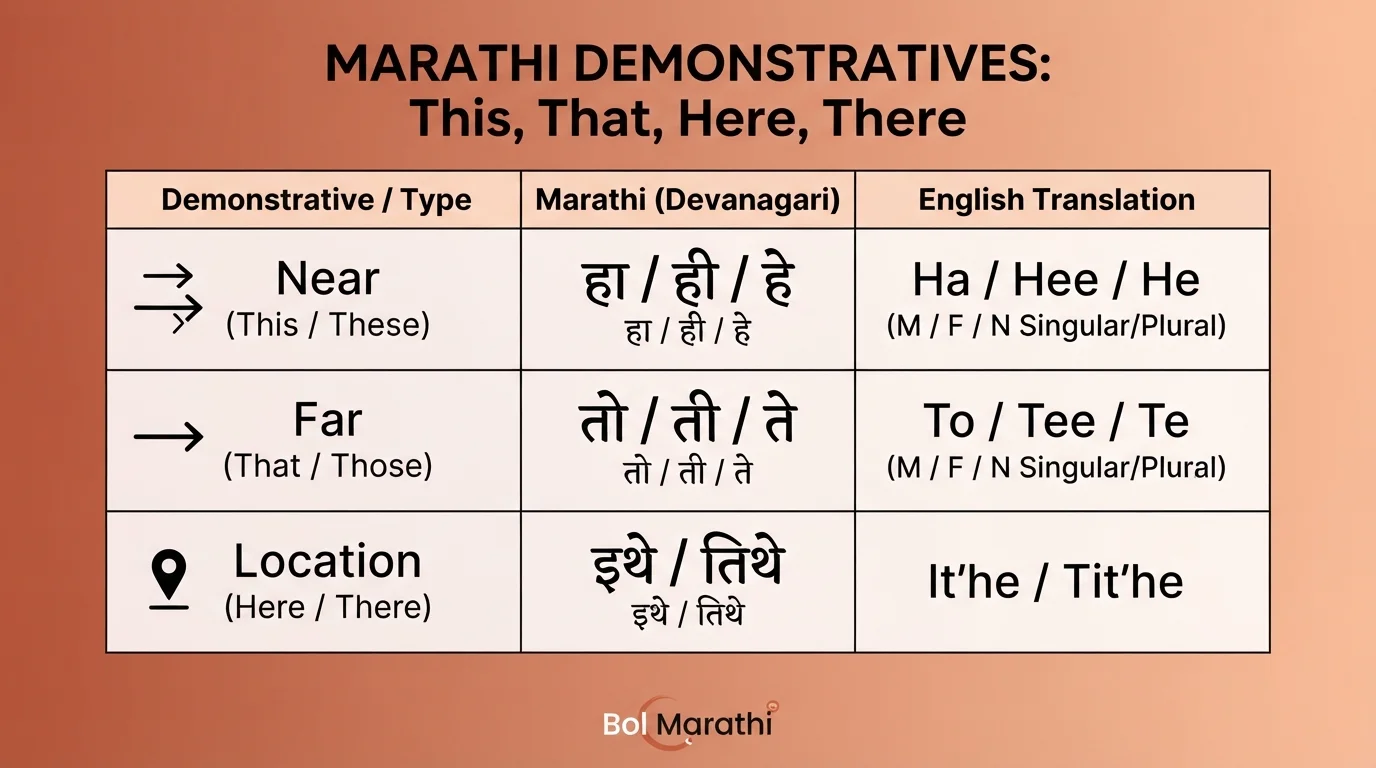
Demonstratives from Unit 05 (Lesson 2): this/that (हा/ही/हे, तो/ती/ते), here/there (इथे/तिथे), like-this/like-that (असा/तसा). Each set agrees in gender — masculine, feminine, neuter — matching the noun they point to.
Hindi speakers: the near/far split (यह/वह, यहाँ/वहाँ) maps directly. The new work is the neuter gender (हे/ते) and the consistent gender agreement across all sets (हा/ही/हे, तो/ती/ते, इथे/तिथे, असा/तसा).
Tip: Gender follows the noun: हा पेन (masc), ही बहीण (fem), हे पाणी (neut). The same split applies to तो/ती/ते, इथे/तिथे, असा/तसा.
The three-gender grid
Near (this/here/like-this): हा (masc), ही (fem), हे (neut), इथे (here), असा (like-this). Far (that/there/like-that): तो (masc), ती (fem), ते (neut), तिथे (there), तसा (like-that). The gender is always marked on the demonstrative, never on the noun alone.
Agreement chain — possessives, adjectives, demonstratives
Once you know हा/ही/हे for a noun, the same gender carries to possessives (माझा/माझी/माझं), adjectives (मोठा/मोठी/मोठे), and relatives (जो/जी/जे). The grid is one system, not three separate memorizations.
Common mistakes
✗ Using हा for a feminine noun✓ ही for feminine: ही बहीण, ही खुर्ची, ही पुस्तक
The demonstrative must match the noun's gender. हा बहीण is ungrammatical — the sister is feminine, so ही.
✗ Assuming इथे/तिथे have gender✓ इथे/तिथे are locative — no gender, just near/far
इथे = here (near speaker), तिथे = there (away). They don't agree with a noun; they point to location.
✗ Using असा for a masculine noun✓ असा matches the noun: असा पेन (masc), अशी बहीण (fem), असे पाणी (neut)
Like-this/like-that carries gender too — the same split as हा/ही/हे.
Quick practice
Answer first, then open the reveal to check yourself.
1. "This book" (neuter) in Marathi?
Answer: C. हे पुस्तक — पुस्तक is neuter → हे पुस्तक.
2. "That" (feminine) in Marathi?
Answer: B. ती — ती = that (feminine).
3. "Here" in Marathi?
Answer: A. इथे — इथे = here (near speaker). तिथे = there.
4. Fill in the blank: ___ पाणी शीत आहे. (This water is cold.)
हे — पाणी is neuter → हे.
You've learned the pattern.
Build your own sentences, get instant feedback, and master the grammar.
Common questions
How many genders do Marathi demonstratives have?
Three — masculine (हा/तो), feminine (ही/ती), neuter (हे/ते). The demonstrative always matches the noun's gender.
What is the difference between इथे and तिथे?
इथे = here (near the speaker), तिथे = there (away from the speaker). They are locative and do not carry gender.